
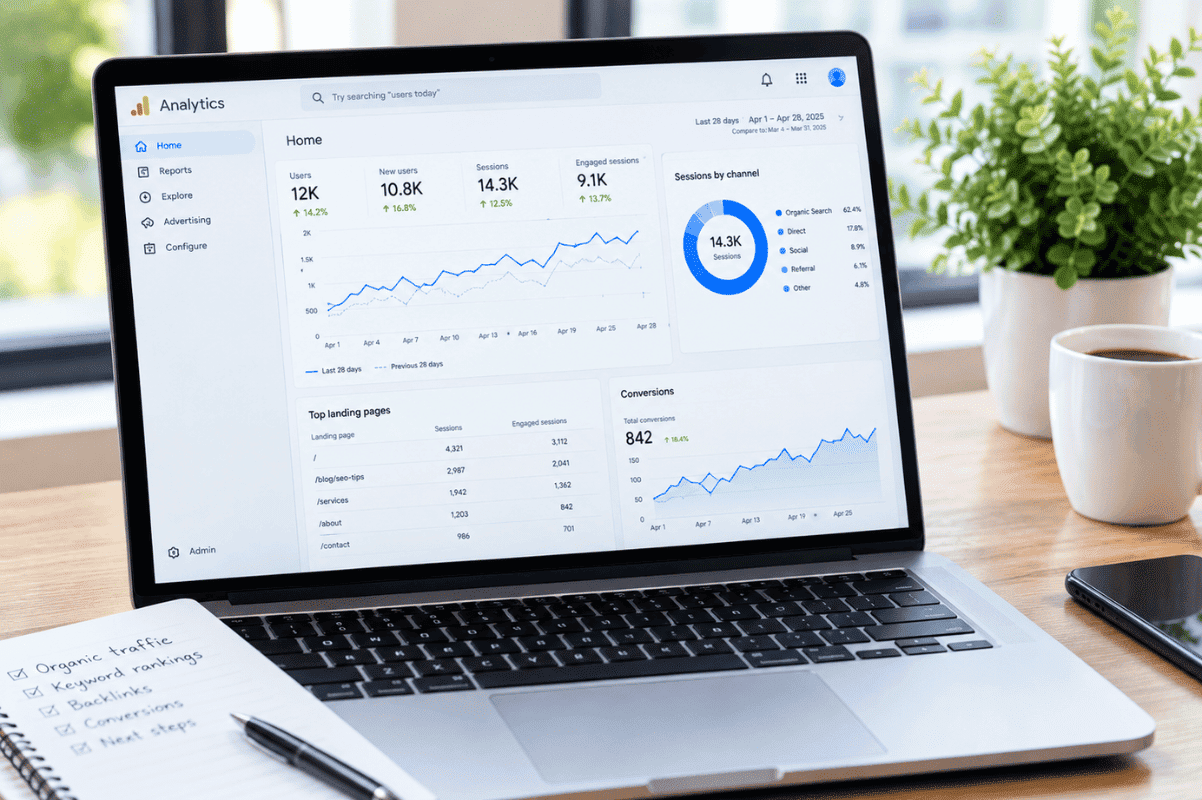
An SEO campaign can generate hundreds of numbers, but a good report should not overwhelm the reader with all of them.Clients, managers, and marketing teams usually want answers to a few important questions: What happened? Why did it happen? What is improving? What needs attention? And what should we do next?That is the real purpose of SEO reporting.A useful SEO report turns search data into a clear story about website performance. Instead of simply showing rankings, traffic charts, or backlink counts, it connects those metrics to business goals and explains what they mean.Whether you are reporting weekly, monthly, or quarterly, this guide explains what to include, which metrics deserve attention, how to create SEO reports efficiently, and what a practical SEO report can look like.
What Is SEO Reporting?
SEO reporting is the process of collecting, analysing, and presenting search engine optimization data to understand how a website is performing in organic search.
A report can include information about:
- Organic traffic
- Search impressions
- Clicks
- Keyword rankings
- Click-through rate
- Landing pages
- Conversions
- Backlinks
- Referring domains
- Technical SEO
- Content performance
- Competitor visibility
The exact metrics should depend on the website and its goals.For example, an ecommerce business may focus heavily on organic revenue and product-page performance, while a local service business may care more about organic leads, service-page visibility, and local search performance.A strong report answers business questions instead of simply presenting data.
Why SEO Reporting Matters
Without consistent reporting, it can be difficult to determine whether an SEO strategy is actually producing meaningful progress.
Regular reporting helps teams:
- Identify growth and declines
- Find pages that need attention
- Measure progress against targets
- Understand which content performs well
- Monitor keyword visibility
- Evaluate link-building activity
- Identify technical problems
- Communicate results with clients and stakeholders
- Decide what to prioritise next
It also creates a historical record.
A single month’s ranking movement may not tell you much. Comparing several months can reveal a much clearer trend.
SEO Reporting: The Core Metrics to Include
Not every SEO report needs every possible metric. Start with the measurements that answer the most important questions.
1. Organic Traffic
Organic traffic shows how many visitors reach your website through unpaid search results.When reporting organic traffic, avoid showing only one total number.
Break it down where useful by:
- Landing page
- Country or region
- Device
- Search type
- New versus returning users
- Conversion activity
Also compare the current period with a relevant previous period.
For example, you might compare:
Current month vs previous month
or
Current month vs same month last year
Year-over-year comparisons can be particularly useful when seasonality affects search behaviour.
2. Organic Conversions
Traffic is useful, but it is not always the final business objective.Your report should show meaningful actions generated by organic visitors where reliable tracking is available.
These may include:
- Contact form submissions
- Phone enquiries
- Quote requests
- Purchases
- Account registrations
- Downloads
- Appointment requests
This helps answer a more important question:Is organic search attracting visitors who actually matter to the business?A website may gain traffic without gaining leads or revenue. That is why conversion data should sit alongside traffic data.
3. Keyword Rankings
Keyword rankings can help show how a website’s visibility is changing.Rather than reporting hundreds of keywords without context, focus on strategically important terms.
Your report might group keywords into:
- Top 3 positions
- Top 10 positions
- Page-two opportunities
- Commercial keywords
- Informational keywords
- Branded keywords
- Location-based keywords
It can also be useful to show changes from the previous reporting period.
For example:
| Keyword Group | Previous Period | Current Period | Change |
| Top 3 | 18 | 24 | +6 |
| Top 10 | 51 | 63 | +12 |
| Page 2 | 37 | 29 | -8 |
The numbers in an actual report should come from your own verified tracking data.
4. Impressions and Clicks
Search impressions indicate how often your pages appeared in search results, while clicks show how often users selected those results.Looking at both metrics can reveal useful patterns.For example, if impressions increase but clicks remain relatively flat, your pages may be appearing more often without generating proportional traffic.
That can lead to a closer review of:
- Search intent
- Search-result appearance
- Page titles
- Meta descriptions
- Ranking positions
- SERP features
- Competition
5. Click-Through Rate
Click-through rate, or CTR, shows the proportion of impressions that resulted in clicks.
CTR should not be treated as an isolated SEO score.
Compare it alongside impressions, rankings, query type, and search-result context.
A page ranking near the top for a highly relevant query may have very different CTR behaviour from a page appearing lower in the results.
6. Landing Page Performance
Your SEO report should show which pages receive organic traffic and how those pages perform.
Important landing pages may include:
- Homepage
- Service pages
- Product pages
- Category pages
- Blog articles
- Location pages
- Resource pages
Look for pages that are gaining visibility and pages that are losing traffic.A declining page deserves investigation rather than an automatic rewrite. Changes in search demand, competition, technical issues, content freshness, and search intent can all be relevant.
SEO Reporting Analytics: Backlinks and Authority
For campaigns that include link building, backlink data deserves its own section.
7. New Backlinks
Report meaningful new backlinks acquired during the period.
Useful information may include:
- Linking website
- Target page
- Relevant topic
- Link placement
- Acquisition date
- Follow/nofollow attributes where relevant
Avoid presenting backlink volume as the only measure of success.A smaller number of relevant links from useful websites can tell a more meaningful story than a large number of low-value links.
8. Referring Domains
Referring domains show how many different websites link to your website.
Tracking this over time can help you understand whether your backlink profile is becoming broader.
You can also identify which pages are attracting external links and which valuable pages may need additional link-building attention.
9. Lost Backlinks
Lost links can be worth monitoring, particularly when they point to important pages.
If a valuable backlink disappears, investigate whether:
- The linking page was removed
- The URL changed
- The website redesigned its content
- The link was intentionally removed
- A redirect changed the destination
This can sometimes create an opportunity for link recovery.
Technical SEO Reporting
Technical information should be included when it affects search visibility, crawling, indexing, or user experience.
10. Indexing and Crawling
Report important issues such as:
- Pages unintentionally excluded from indexing
- Crawl errors
- Broken URLs
- Redirect problems
- Canonicalisation issues
- Sitemap problems
- Robots.txt changes
Do not overwhelm the client with every technical warning generated by a tool.Instead, explain the issues that deserve attention and their potential impact.
11. Site Health and Performance
Depending on the website, technical reporting may include:
- Core Web Vitals
- Mobile usability
- Page performance
- HTTPS/security issues
- Broken internal links
- Redirect chains
- Duplicate pages
- Indexability
The most useful format is usually issue → impact → recommended action.
For example:
Issue: Several important pages contain broken internal links.
Impact: Users and crawlers may encounter unnecessary dead ends.
Action: Replace outdated links with relevant live URLs.
That is more useful than simply reporting “12 broken links”.
Content Performance in SEO Reports
Content should have a dedicated section when content marketing is part of the SEO strategy.
12. Top-Performing Content
Show articles or pages that have performed well during the reporting period.
You can evaluate them using:
- Organic traffic
- Search impressions
- Clicks
- Rankings
- Conversions
- Backlinks
Then identify what successful pages have in common.
13. Content That Needs Improvement
A good report should not only celebrate winners.
Identify pages that:
- Lost organic traffic
- Lost important rankings
- Have high impressions but low clicks
- No longer satisfy search intent
- Contain outdated information
- Have weak internal linking
- Compete with another page
These pages can become part of the next month’s action plan.
How to Create SEO Reports That Clients Actually Understand
A report should be easy to scan.
Start with an executive summary before presenting detailed data.
Example Executive Summary
Organic performance: Organic traffic increased compared with the previous reporting period.
Visibility: Several target terms improved, while a small group of priority terms declined.
Content: Two existing articles gained substantial search visibility and should receive additional internal links.
Links: New relevant referring domains were acquired during the period.
Technical: A group of broken internal links requires correction.
Next steps: Prioritise technical fixes, strengthen internal linking, and review declining priority pages.
This format allows a busy stakeholder to understand the situation without studying every chart.

A Practical SEO Report Template
You can structure a monthly report like this:
1. Executive Summary
- Major wins
- Major concerns
- Key changes
- Recommended priorities
2. Organic Performance
- Organic traffic
- Clicks
- Impressions
- CTR
- Conversions
3. Keyword Performance
- Priority keywords
- Ranking changes
- New ranking opportunities
- Lost visibility
4. Content Performance
- Top pages
- Declining pages
- Newly published content
- Content recommendations
5. Backlink Performance
- New backlinks
- Referring domains
- Lost links
- Important link opportunities
6. Technical SEO
- Indexing
- Crawling
- Broken links
- Performance
- Other priority technical issues
7. Recommendations
- What should be fixed?
- What should be improved?
- What should be created?
- What should be monitored?
8. Next-Month Priorities
End with a short list of specific actions.
This makes the report a working document rather than simply a record of what happened.
SEO Reporting Mistakes to Avoid
Reporting Too Many Metrics
More data does not automatically create more insight.
Only include metrics that help explain performance or support a decision.
Focusing Only on Rankings
Ranking position matters, but it should be considered alongside traffic, search visibility, conversions, and business outcomes.
Using Vanity Metrics
A metric can look impressive without having much business value.
Always ask:
Does this number help us understand performance or make a better decision?
Hiding Negative Results
A trustworthy report should acknowledge declines as well as improvements.
Explain what changed, investigate possible causes, and provide a practical response.
Failing to Explain the Numbers
A chart without context leaves the reader to interpret the result themselves.
Add a short explanation describing what changed and what the team plans to do about it.
How Often Should You Create SEO Reports?
The reporting schedule should match the campaign and business.Weekly reports can be useful for internal monitoring and campaigns experiencing significant changes.Monthly reports are commonly useful for client communication because they provide enough data to identify meaningful trends without waiting too long.Quarterly reports are better suited to strategic reviews, larger trend analysis, and planning.For most ongoing campaigns, a combination works well: monitor important metrics regularly, provide detailed monthly reporting, and conduct a deeper strategic review each quarter.
SEO Reporting Checklist
Before sending an SEO report, check that it includes:
- Executive summary
- Organic traffic
- Organic conversions
- Impressions and clicks
- CTR
- Keyword performance
- Landing-page performance
- Content performance
- New backlinks
- Referring domains
- Lost important links
- Technical SEO issues
- Indexing information
- Key wins
- Areas requiring attention
- Recommended actions
- Next-period priorities
Effective SEO reporting is not about putting every available metric into a spreadsheet.It is about turning search data into a clear explanation of performance and a practical plan for improvement.The strongest reports combine organic traffic, conversions, rankings, search visibility, content, backlinks, and technical findings while keeping the focus on business objectives. When you create SEO reports this way, clients and growth teams can see not only what changed, but also why it matters and what should happen next.If your business is working on improving organic visibility and building a stronger backlink profile, BuyBacklinks.ca can help you develop a focused link-building strategy that fits your broader SEO goals.
5. FAQ Section
What should an SEO report include?
An SEO report should typically include organic traffic, conversions, keyword rankings, impressions, clicks, CTR, landing-page performance, content results, backlinks, referring domains, technical SEO findings, and recommended next steps.
How often should SEO reports be created?
Monthly reporting is often useful for ongoing campaigns because it provides enough data to identify meaningful trends. Weekly monitoring and quarterly strategic reviews can complement monthly reports.
What are the most important SEO reporting metrics?
The most useful metrics depend on the business. Organic conversions, organic traffic, rankings, search impressions, clicks, CTR, landing-page performance, and relevant backlink data are commonly valuable.
Should backlinks be included in an SEO report?
Yes, when link building is part of the SEO strategy. Report meaningful new backlinks, referring domains, important lost links, and relevant link-building opportunities rather than focusing only on total link volume.
How do I create SEO reports for clients?
Start with an executive summary, then present organic performance, keyword changes, content, backlinks, technical SEO, and recommendations. Explain significant changes in plain language and finish with clear next steps.
Should SEO reports include negative results?
Yes. A credible report should show both positive and negative changes. Explain what declined, investigate likely causes carefully, and provide an action plan for addressing the issue.
