
A website can look perfectly normal to a visitor and still have SEO problems working behind the scenes.Important pages may not be indexed. Search engines may struggle to crawl certain sections. Redirects can create unnecessary paths, internal links may point to outdated URLs, and technical issues can make valuable content harder to discover.These problems are not always visible from the front end.That is why professional SEO audit services can be useful. A properly conducted audit looks beyond surface-level SEO metrics and examines how a website is built, crawled, indexed, structured, and presented to search engines and users.For businesses investing in organic search, an audit can provide a clearer picture of what needs attention before more time and resources are invested in content, link building, or other SEO activities.This guide explains what a professional technical SEO audit includes, what an SEO audit can uncover, what the process typically looks like, and what you should expect from a quality audit service.
What Are SEO Audit Services?
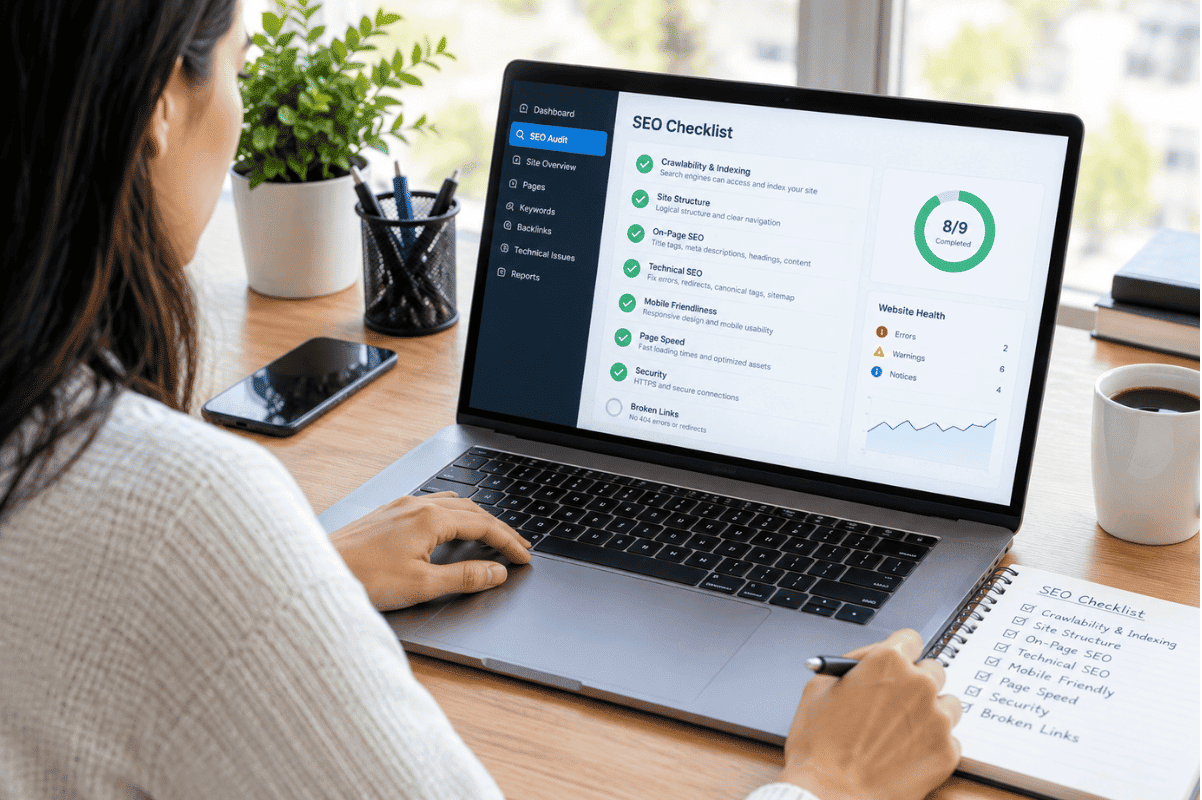
SEO audit services involve a structured examination of a website to identify technical, content, on-page, internal linking, and other SEO issues that may affect organic search visibility.
A professional audit may examine:
- Crawling and indexing
- Robots.txt
- XML sitemaps
- HTTP status codes
- Redirects
- Canonical URLs
- Internal links
- Website architecture
- Page titles and headings
- Duplicate or thin content
- Mobile usability
- Page performance
- Structured data
- Backlinks
- Search performance
- Content and search intent
The exact scope depends on the website.A small local business website may require a different audit from a large ecommerce store with thousands of URLs.The purpose is not to produce the longest possible list of errors. It is to identify the issues and opportunities that are most relevant to the website’s search performance and business objectives.
Why Does a Technical SEO Audit Matter?
Google explains that Search works through processes including crawling, indexing, and serving search results. If search engines cannot properly access or understand important pages, a website may miss opportunities to appear for relevant searches.A technical audit helps uncover potential obstacles within that process.
For example, an audit might discover that:
- Important URLs are blocked from crawling
- Valuable pages have an unintended noindex directive
- Internal links lead to broken pages
- Multiple URLs represent the same or similar content
- Redirects are unnecessarily complicated
- Important pages are difficult to reach through the site’s structure
- Technical changes have affected search visibility
- Mobile or performance problems need attention
Not every issue will have the same impact. A professional audit should distinguish between critical problems, useful improvements, and minor recommendations.
What a Professional Technical SEO Audit Includes
1. Website Crawling and Indexing
Crawling and indexing are among the first areas an SEO professional should examine.Google states that its crawlers discover pages on the web and then process pages for inclusion in its index. Google also notes that meeting technical requirements does not guarantee that a page will be indexed.
An audit may therefore examine:
- Which pages can be crawled
- Which pages are blocked
- Noindex directives
- Canonicalisation
- HTTP status codes
- Redirects
- Indexing exclusions
- Orphan pages
- Important pages missing from search visibility
The goal is to determine whether the site’s technical setup supports the pages that the business actually wants search engines to discover and index.
2. Robots.txt Review
The robots.txt file can influence which areas of a website crawlers are allowed to access.A professional audit checks whether the file contains rules that unintentionally restrict important content.It is also important to understand what robots.txt does not do. Google specifically notes that robots.txt is not a mechanism for keeping a page out of Google’s index. Other controls, such as appropriate noindex rules, may be needed depending on the situation.
3. XML Sitemap Analysis
An XML sitemap can help search engines discover important URLs.
During an audit, the sitemap may be checked for:
- Invalid URLs
- Redirected URLs
- Non-canonical URLs
- Pages that should not be indexed
- Missing important URLs
- Formatting or accessibility issues
However, a sitemap is not a guarantee of indexing. Google explicitly states that submitting a sitemap does not guarantee that URLs will be indexed or improve their ranking.
4. URL and Redirect Analysis
URLs should be understandable and technically accessible.
An audit may identify:
- Broken URLs
- 404 errors
- 3xx redirects
- Redirect chains
- Redirect loops
- Inconsistent URL formats
- Unnecessary URL parameters
- Changes from previous site versions
This becomes especially important during website redesigns or migrations.A page that previously received organic traffic can lose visibility if its URL changes without an appropriate migration and redirect strategy.
On-Page SEO Review
Technical SEO is only one part of a professional audit.
5. Title Tags and Meta Descriptions
The audit should review important pages for:
- Missing title tags
- Duplicate titles
- Poorly descriptive titles
- Missing or duplicated meta descriptions
- Titles that do not match search intent
- Unnatural keyword usage
These elements should accurately represent the page rather than simply repeat keywords.Google’s Search Essentials also warns against keyword stuffing, which includes repeating keywords or phrases unnaturally in an attempt to manipulate rankings.
6. Heading Structure
Headings help organise content for readers and provide useful context about a page.
An audit may review:
- H1 usage
- H2 and H3 hierarchy
- Missing headings
- Duplicate headings
- Unclear headings
- Over-optimized headings
The goal is a logical structure that makes the page easier to understand and navigate.
7. Content Quality and Search Intent
A technical audit should not ignore content.
Review whether important pages:
- Address the intended search query
- Provide useful information
- Match the user’s likely intent
- Contain outdated information
- Overlap unnecessarily with other pages
- Have sufficient internal support
- Provide a clear next step where appropriate
A technically clean website can still struggle if its content does not satisfy the needs behind relevant searches.
Internal Linking and Site Architecture
8. Internal Link Analysis
Internal links help users navigate a website and help search engines discover relationships between pages.
A professional audit can identify:
- Broken internal links
- Pages with very few internal links
- Important pages buried too deeply
- Excessive links to low-value pages
- Opportunities to connect related content
- Links pointing to redirected URLs
The goal is not to add links everywhere.
Internal linking should be useful, logical, and relevant.
9. Website Architecture
An audit should also examine how the website is organised.
For example, a service-based business might have a structure similar to:
Homepage → Services → Individual Service Pages → Supporting Content
An ecommerce website may use categories, subcategories, product pages, and supporting informational content.
The appropriate structure depends on the business, but important pages should have a logical path through the website.
Mobile and Page Performance Checks
10. Mobile Experience
A professional audit should examine how important pages work on mobile devices.
Check:
- Navigation
- Text readability
- Buttons
- Forms
- Images
- Menus
- Pop-ups
- Horizontal scrolling
- Page layout
A page that functions well on a desktop but creates problems on smaller screens can still provide a poor user experience.
11. Page Performance and Core Web Vitals
Performance is another area worth reviewing.An audit may examine loading behaviour and Core Web Vitals, along with broader page-performance factors.Google’s developer guidance recommends that websites be secure, fast, accessible, and functional across devices.However, performance scores should be interpreted rather than treated as a single pass-or-fail SEO number.A professional audit should identify which performance issues affect real pages and what practical improvements may be appropriate.
Structured Data and Search Appearance
12. Structured Data Review
Structured data can provide explicit information about page content and can help Google understand certain types of content.
An audit may check:
- Whether structured data is present where appropriate
- Whether the implementation is valid
- Whether markup accurately represents visible content
- Whether important properties are missing
- Whether errors need correction
Google explains that structured data can provide clues about the meaning of a page and can make some pages eligible for rich-result features.
Eligibility, however, does not mean a rich result will necessarily appear.
Backlink and Off-Page Review
13. Backlink Profile
Professional SEO audit services may also include an examination of a website’s backlink profile.
The review can include:
- Referring domains
- Important backlinks
- Lost backlinks
- Links to key pages
- Anchor-text patterns
- Potentially problematic link patterns
- Overall link relevance
The objective is not simply to count backlinks.Google’s spam policies identify link spam as links created primarily to manipulate search rankings.A professional audit should therefore look at the quality, relevance, context, and overall pattern of a website’s links rather than recommending indiscriminate link acquisition.
Search Performance Analysis
14. Google Search Console Data
A strong audit should connect technical findings with actual search performance.Google Search Console’s Performance report provides information including clicks, impressions, CTR, and average position. It can also be grouped by queries, pages, countries, devices, and other dimensions.
An SEO professional can use this information to investigate:
- Traffic declines
- Pages gaining visibility
- Pages losing visibility
- Queries generating impressions but few clicks
- Important pages with limited search exposure
- Changes over different periods
Google recommends focusing on trends in impressions and clicks rather than relying on average position alone.
This is important because search performance data needs context.
What Should You Receive From an SEO Audit Service?
A professional audit should result in more than a collection of screenshots.
Depending on the scope, you should expect a report that explains:
Key Findings
What are the major problems or opportunities?
Business Impact
Why does each important issue matter?
Priority
Which items should be addressed first?
Recommended Actions
What should be changed?
Implementation Guidance
Where practical, explain what the recommended fix involves.
Supporting Evidence
Include relevant URLs, examples, screenshots, crawl findings, or search data where useful.
The best report is one your team can actually use to plan work.
How to Choose SEO Audit Services
Before hiring an SEO provider, ask what the audit actually includes.
Useful questions include:
- Will the audit examine technical SEO and indexing?
- Will important pages be reviewed individually?
- Will Google Search Console data be considered?
- Will content and search intent be analysed?
- Will internal links and site architecture be reviewed?
- Will backlinks be included if relevant to the project?
- Will findings be prioritised by impact?
- Will the report include practical recommendations?
- Will the provider explain the findings?
- Does the service include a follow-up discussion or implementation guidance?
Be cautious about providers promising guaranteed rankings. Google states that meeting its technical requirements and best practices does not guarantee crawling, indexing, or search placement.
When Should You Get a Technical SEO Audit?
A technical audit can be particularly useful when:
- Organic traffic has declined unexpectedly
- Important pages are not appearing in search
- A website has recently been redesigned
- The domain or URL structure has changed
- A migration has taken place
- The website has grown significantly
- Search performance has stagnated
- There are widespread technical warnings
- A new SEO strategy is being developed
- You are preparing for a major content or link-building campaign
It can also be useful as a baseline before beginning a larger SEO project.

How Often Should a Website Be Audited?
There is no universal schedule.A smaller, stable website may need a comprehensive audit less frequently, combined with ongoing monitoring.Larger websites, ecommerce platforms, publishers, and sites undergoing frequent changes may benefit from more regular technical reviews.It is also sensible to conduct an audit after significant changes such as a website migration, major redesign, CMS change, or substantial URL restructuring.Professional SEO audit services provide a structured way to understand what may be helping or limiting a website’s organic search performance.A comprehensive technical audit can examine crawling, indexing, robots.txt, sitemaps, redirects, URLs, internal links, site architecture, on-page elements, content, mobile experience, performance, structured data, backlinks, and search performance.The most useful audit is not necessarily the one with the longest list of issues. It is the one that identifies meaningful problems, explains their potential impact, prioritises the work, and gives your team a practical path forward.If you’re looking for support with technical SEO and a broader link-building strategy, BuyBacklinks.ca can help you assess your website’s needs and develop an SEO approach based on your current goals.
5. FAQ Section
What are SEO audit services?
SEO audit services are professional reviews of a website’s technical, on-page, content, internal linking, backlink, and search-performance factors. The purpose is to identify issues and opportunities that may affect organic visibility.
What does a technical SEO audit include?
A technical audit can include crawling and indexing, robots.txt, XML sitemaps, redirects, HTTP status codes, canonical URLs, site architecture, internal links, mobile usability, page performance, and other technical factors.
How long does an SEO audit take?
The time required depends on the website’s size, complexity, number of URLs, technical setup, and audit scope. A small business website generally requires less analysis than a large ecommerce or publishing website.
How often should I get an SEO audit?
The appropriate frequency depends on how often the website changes and its complexity. A stable site may need less frequent comprehensive audits, while larger or frequently updated sites may require more regular reviews. Major migrations and redesigns are also good times for an audit.
Can an SEO audit improve rankings?
An audit itself does not directly improve rankings. It identifies problems and opportunities. Implementing appropriate recommendations can improve technical accessibility, content quality, site structure, and other aspects that support search performance.
What should a professional SEO audit report contain?
A useful report should explain the key findings, affected pages or areas, potential business impact, priority level, recommended actions, and supporting evidence. It should give the team a practical implementation plan rather than simply listing errors.
