
Publishing blog posts, updating page titles, and building links can keep a marketing team busy. But activity alone does not tell you whether your SEO campaign is helping the business grow.
An effective campaign connects each task to a specific outcome: attracting relevant visitors, generating qualified enquiries, or increasing sales. It also gives you a way to measure progress and decide what to improve next.
Whether you manage a Canadian small business or coordinate marketing for several clients, the process follows the same sequence: define the goal, establish your baseline, choose your opportunities, execute the work, and report on outcomes.
Here is how to put that process into practice.
1. Start Your SEO Campaign With a Business Goal
Before choosing keywords, decide what the campaign needs to achieve.
“Get more traffic” is too broad to guide spending or prioritisation. A useful objective identifies the audience, desired action, and timeframe.
For example, a hypothetical Calgary renovation company might aim to increase qualified organic enquiries for basement renovations over six months.
That objective helps the team focus on relevant service pages, local customer questions, and enquiry tracking.
Write a short campaign brief covering:
- Business objective: What outcome matters?
- Target audience: Who should find the website?
- Geographic focus: Which cities, provinces, or markets matter?
- Priority offering: Which service or product needs support?
- Primary measurement: How will success be assessed?
- Resources: Who will do the work, and what budget is available?
Set numerical targets after reviewing existing performance. An ambitious target should still have a defensible starting point.
2. Establish a Baseline Before Making Changes
A baseline gives future results context. Without one, it is difficult to distinguish improvement from normal variation.
Record current organic traffic, enquiries or sales, priority landing pages, and search visibility. For seasonal businesses, include year-over-year comparisons where historical data is available.
Google Search Console provides clicks, impressions, click-through rate, and average position. You can examine performance by query, page, country, and device. For a Canadian campaign, the country filter helps separate Canadian search performance from other markets. See Google’s Performance report documentation.
Use your website analytics and customer records to understand what happens after someone arrives.
Before launch, test the actions you plan to measure:
- Does a successful enquiry submission register correctly?
- Are purchases recorded without duplication?
- Can the sales team distinguish qualified leads from spam?
- Are phone enquiries handled consistently?
Keep a dated change log throughout the campaign. Record major page edits, launches, technical fixes, and tracking changes so later reports have useful context.

3. Map Keywords to Search Intent and Pages
Keyword research should help you understand customer needs, not simply produce a long spreadsheet.
Start with your services, products, customer questions, and existing search queries. Then group related searches according to what the person wants to accomplish.
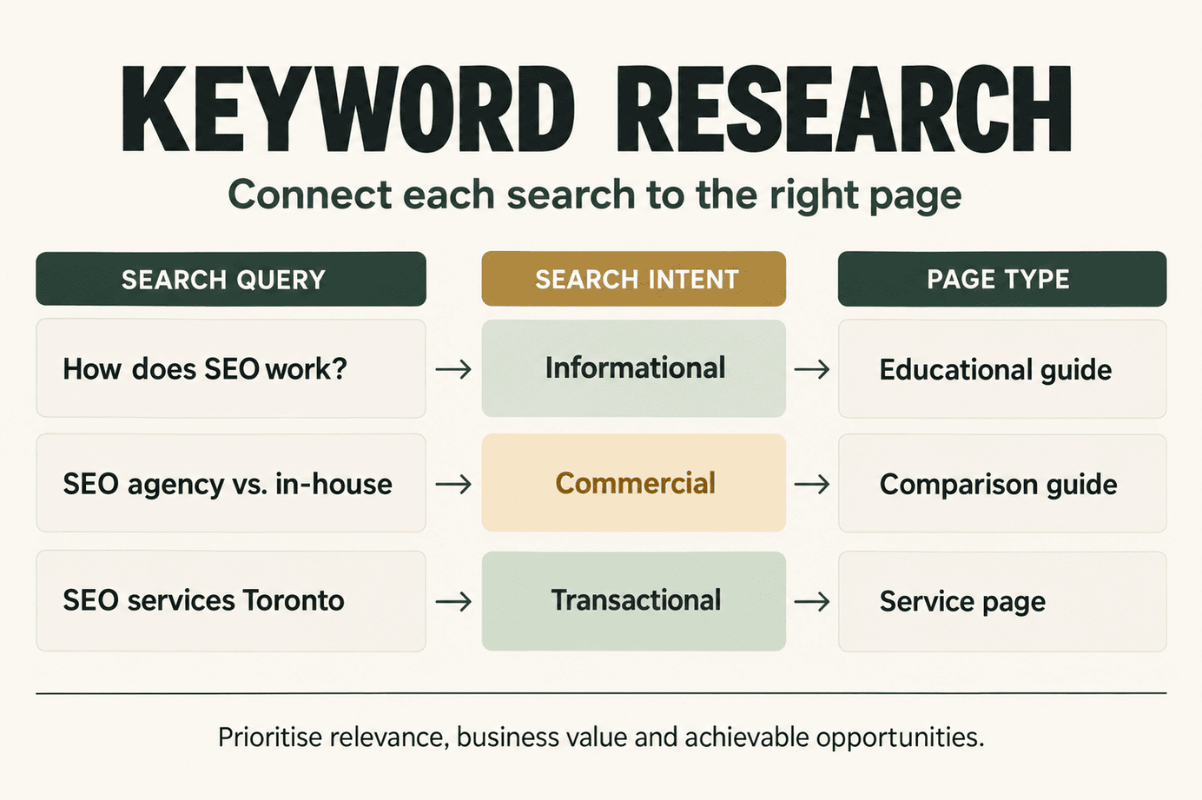
| Search intent | Example query | Suitable page |
| Informational | How does basement waterproofing work? | Educational guide |
| Commercial | Interior vs. exterior waterproofing | Comparison guide |
| Transactional | Basement waterproofing company Ottawa | Relevant service page |
| Navigational | A specific company’s contact details | Contact page |
Review the search results for important terms in your target market. Notice which page types appear and what questions they answer.
Assign each keyword group to the most suitable existing or planned page. Closely related phrases can often belong together rather than requiring separate articles.
For instance, “SEO campaign,” “SEO campaign management,” and “SEO marketing campaign” can fit naturally within a comprehensive guide.
Prioritise opportunities using relevance, business value, current visibility, competition, and the effort required. A modest-volume query from a potential customer may deserve more attention than a broad term with little connection to your offering.
4. Audit the Website and Prioritise Fixes
An audit becomes useful when it produces decisions.
Review technical accessibility, content quality, navigation, and the path from landing page to conversion. Ask whether important pages are accessible, understandable, and useful on mobile devices.
For technical checks, inspect whether priority pages can be crawled and indexed. Google recommends its URL Inspection tool to understand how it sees a page. Its SEO Starter Guide explains the fundamentals.
Then assess the visitor experience:
- Does the page answer the searcher’s main question?
- Are service details and geographic coverage clear?
- Are important internal links working?
- Is the next action easy to find?
- Does the enquiry or checkout process work?
Rank findings by business impact, urgency, effort, and dependencies.
A broken enquiry form on a high-value service page should usually take priority over minor wording changes on an older blog post. Give each task an owner and a clear definition of completion.
5. Build a Practical SEO Campaign Management Plan
Good SEO campaign management turns recommendations into scheduled work.
Create a shared tracker containing the task, target page, owner, deadline, status, and intended outcome. Include approval steps so finished work does not sit unpublished.
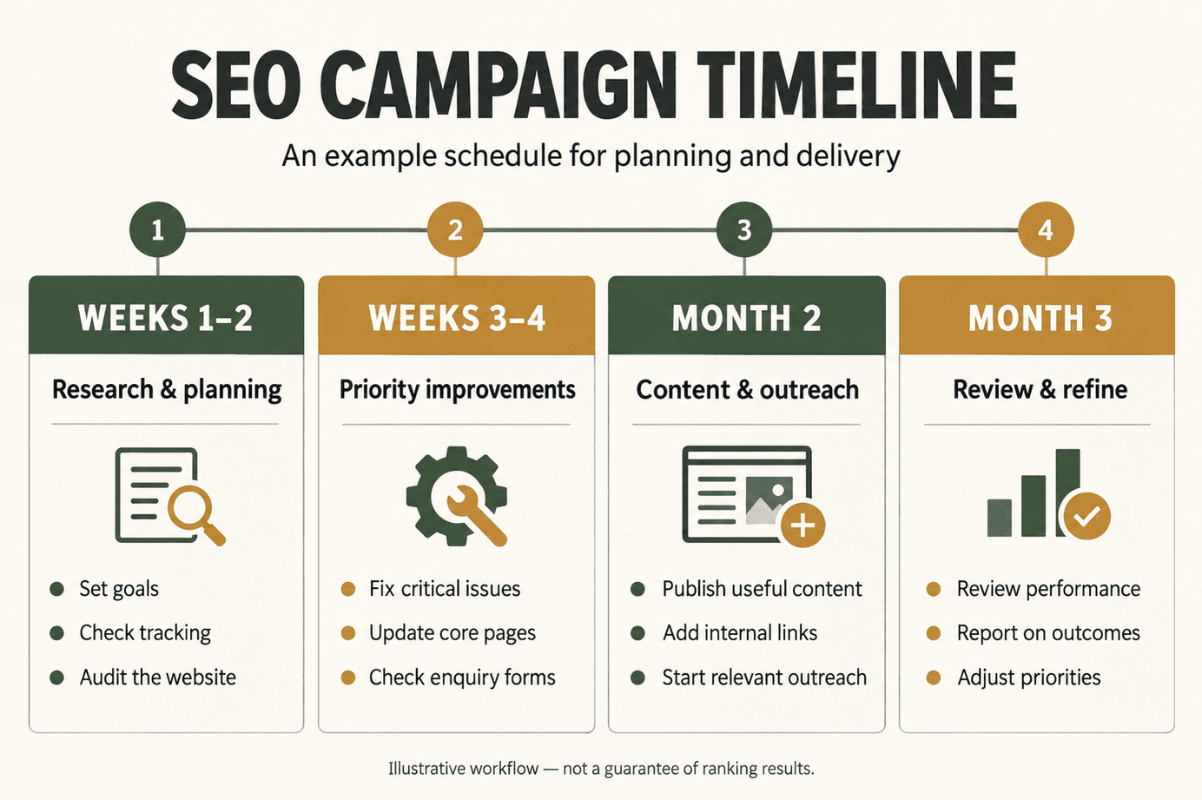
A useful starting schedule might look like this:
| Phase | Main work | Deliverable |
| Weeks 1–2 | Goals, tracking checks, research, audit | Campaign brief and prioritised backlog |
| Weeks 3–4 | Critical fixes and priority page updates | Improved core pages |
| Month 2 | Supporting content and outreach | Published resources and outreach records |
| Month 3 | Performance review and refinement | Updated priorities and progress report |
This is an organisational example, not a promise of results within three months.
Build the budget around the work required: research, writing, development, design, outreach, and reporting. Leave room for unexpected technical issues.
Hold a short weekly review to resolve blockers. Use a monthly review to evaluate performance and adjust priorities.
6. Create Content That Helps Readers Take the Next Step
Every page should have a clear job.
A service page helps someone evaluate an offering. A comparison explains trade-offs. A tutorial helps the reader complete a task.
Before drafting, prepare a brief that identifies the audience, search intent, main question, supporting questions, evidence needed, and appropriate call to action.
Use details that help customers make decisions: service boundaries, process explanations, genuine examples, relevant qualifications, and transparent limitations.
For Canadian audiences, check spelling, currency, measurements, and regional context. If you serve both English- and French-speaking customers, plan for the needs of each audience.
During editing, review the title, main heading, introduction, section headings, and relevant internal links. Add keywords where they fit naturally.
Avoid creating multiple pages that repeat the same answer with slightly different wording. Improve an existing page when that better serves the reader.
7. Include Outreach and Links With Clear Quality Standards
An SEO marketing campaign may include outreach to help relevant audiences discover useful resources.
Potential approaches include sharing original research, contributing expert commentary, publishing practical tools, and developing relationships with relevant industry organisations.
Evaluate opportunities by audience fit, editorial quality, relevance, and the usefulness of the destination page. A third-party authority score alone does not establish quality.
Google identifies buying or selling links for ranking purposes as link spam. Advertising and sponsorship links are permitted when appropriately qualified with rel=”sponsored” or rel=”nofollow”. Review Google’s link spam policies before approving paid placements.
Ask any provider to explain placement methods, payment arrangements, link attributes, and reporting. Avoid promises of guaranteed rankings.
BuyBacklinks.ca lists backlink audits, blogger outreach, and Canadian link-building services on its website. When evaluating support, discuss how the proposed work fits your broader campaign and Google’s policies.
8. Report on Outcomes and Decide What Happens Next
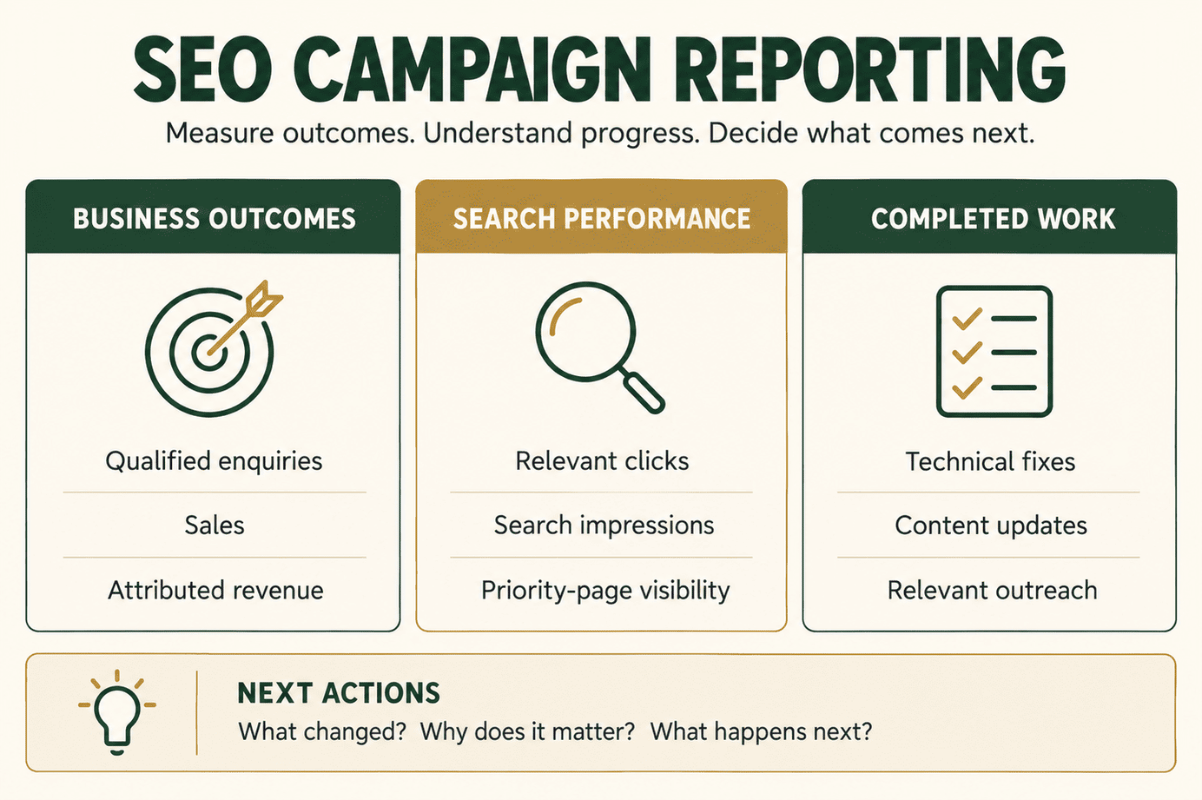
A useful report answers three questions: what changed, why does it matter, and what should happen next?
Organise reporting around three levels:
| Level | What to review | Purpose |
| Business outcomes | Qualified enquiries, sales, attributed revenue | Assess commercial contribution |
| Search performance | Relevant clicks, impressions, priority-page visibility | Understand discovery |
| Completed work | Fixes, content updates, outreach | Explain activity and context |
Separate branded and non-branded queries where practical. Review priority pages individually so site-wide totals do not hide important changes.
Compare equivalent periods and account for seasonality, promotions, website changes, and tracking interruptions. Avoid crediting every increase to SEO.
For example, rising clicks with flat enquiries should trigger a review of search intent, landing-page relevance, and conversion tracking. Falling clicks on one service page call for a more focused investigation.
End each report with a short action list. Assign owners and explain why each action deserves priority.
Turn the Findings Into Your Next Campaign Decisions
A successful SEO campaign is a repeatable process of choosing, implementing, measuring, and improving.
Start with a business goal, focus on relevant opportunities, and keep reporting connected to customer actions. Use the evidence to decide what to continue, change, or stop.
If your next priority is reviewing backlinks or planning outreach, explore BuyBacklinks.ca and discuss how that work could fit your campaign objectives.
Frequently Asked Questions
How long does an SEO campaign take to show results?
There is no universal timeline. Google notes that changes can take effect within hours or take several months, and recommends allowing time before assessing impact. The starting condition of your website and the work involved also matter.
What is the difference between ongoing SEO and an SEO campaign?
Ongoing SEO maintains and improves a website over time. A campaign gives part of that work a defined objective, scope, and review period, such as improving visibility for a particular service or product category.
How much should a Canadian business budget for an SEO campaign?
Build the budget from the required scope rather than a universal price. Account for content, technical development, outreach, tools, and reporting. Request an itemised proposal showing deliverables, responsibilities, exclusions, and how progress will be assessed.
Can I manage an SEO campaign myself?
Yes, if the scope matches your time and skills. Start with a limited set of priority pages and measurable goals. Bring in specialist support when technical problems, content requirements, or reporting needs exceed your capacity.
Which SEO campaign metrics matter most?
Start with qualified enquiries, sales, or another business outcome. Use relevant organic traffic and search visibility to understand how people discover your pages. Rankings and completed tasks provide context, but neither alone demonstrates business success.
