
SEO success is not simply about getting more keywords into the top 10. A website can gain rankings without generating meaningful traffic, and traffic can increase without producing leads or sales. That is why effective seo web analytics should connect search visibility with what happens after someone reaches the website.For businesses investing in content, technical SEO, and link building, the right metrics make it easier to understand whether organic search is actually contributing to business growth. Instead of looking at one number, you need a group of KPIs that shows visibility, traffic quality, engagement, conversions, and authority.
This guide explains the most useful seo data to monitor and how to interpret it without getting distracted by vanity metrics.
What Does SEO Web Analytics Actually Measure?
SEO web analytics combines search performance data with website behaviour data. It helps you understand how people discover your website through search, which pages attract them, what they do after arriving, and whether those visits contribute to business objectives.
Useful SEO reporting can bring together information such as:
- Organic search traffic
- Search impressions and clicks
- Keyword rankings
- Click-through rate
- Landing-page performance
- Engagement
- Conversions and leads
- Revenue attributed to organic search
- Backlinks and referring domains
- Technical SEO issues
- New versus returning organic visitors
The goal is not to collect every available number. The goal is to identify the metrics that answer important business questions.
For example, if organic traffic increases by 30%, that sounds positive. But if conversions remain unchanged, you need to investigate why. The additional traffic may be coming from low-intent searches, informational pages, or keywords that are not closely connected to your products or services.
The Most Important SEO Data for Measuring Growth
Different businesses have different goals, but several KPIs are useful across most SEO campaigns.
1. Organic Search Traffic
Organic traffic shows how many visitors reach your website through unpaid search results.This is one of the most obvious SEO metrics, but it should not be viewed in isolation. Look at traffic trends over time and break them down by landing page, query intent, device, location, and other useful segments.A healthy increase in organic traffic can indicate that your website is gaining visibility for relevant searches.
However, ask:
- Which pages are generating the increase?
- Which search queries are responsible?
- Are visitors engaging with the site?
- Are organic visitors becoming leads or customers?
- Is the growth consistent or limited to a short period?
Traffic becomes much more useful when you connect it to these additional questions.
2. Organic Impressions and Clicks
Search impressions indicate how frequently your pages appear in search results, while clicks show how often users select your pages.These metrics help explain changes in organic traffic.For example, impressions may increase while clicks remain relatively flat. This can indicate that your pages are appearing for more searches but are not receiving enough clicks from those impressions.On the other hand, clicks may increase faster than impressions when existing rankings or search-result visibility improve.Tracking both metrics gives you a clearer picture of how your search visibility is developing.
3. Keyword Rankings
Keyword rankings remain useful because they show where your pages appear for specific searches.But rankings should be treated as a directional KPI rather than the final measure of SEO success.A page ranking #3 for a highly relevant commercial keyword can be more valuable than a page ranking #1 for a search that has little connection to your business.
Track:
- Target keywords
- Ranking position
- Ranking changes
- Search intent
- Related keyword groups
- Pages receiving the rankings
The important question is not simply, “How many keywords rank?”
It is, “Are we ranking for searches that can bring the right audience?”
4. Click-Through Rate
Click-through rate, or CTR, helps show how effectively your search listing attracts clicks from impressions.If a page receives many impressions but relatively few clicks, review the search result presentation. The title and description should clearly communicate what the page offers and match the user’s search intent.CTR can also change depending on the type of search, competition, search features, brand recognition, and the position of the result.That is why CTR should be compared with other seo data instead of being treated as an isolated success metric.
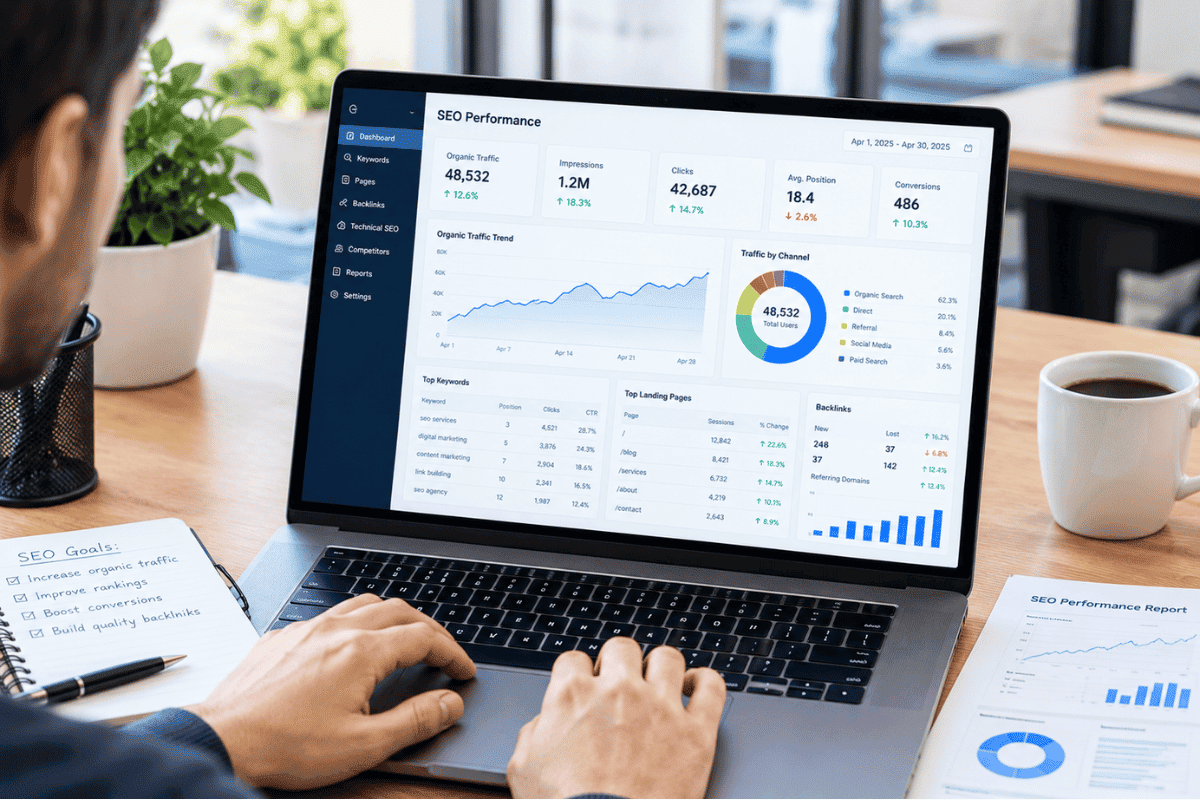
5. Landing-Page Performance
Knowing that your website receives organic traffic is useful. Knowing which pages receive that traffic is even more useful.
Review your main organic landing pages and identify:
- Pages gaining traffic
- Pages losing traffic
- Pages attracting high-intent searches
- Pages generating conversions
- Pages with strong engagement
- Pages that need content updates
This can reveal opportunities that are hidden in website-wide totals.
For example, one service page may be attracting fewer visitors than a blog post but generating substantially more enquiries. That page deserves attention because its traffic has a stronger connection to business results.
6. Organic Conversions and Leads
Conversions are often the KPI that gives SEO reporting real business meaning.
Depending on the website, a conversion could be:
- A contact form submission
- A phone call
- A quote request
- An online purchase
- A booking
- A newsletter signup
- A consultation request
- A product enquiry
Track organic conversions separately where possible. Then compare them with organic traffic to understand whether growth is producing meaningful actions.A campaign that increases traffic but produces no additional business activity deserves further investigation.
7. Conversion Rate From Organic Search
Organic conversion rate helps you understand the quality of search traffic.
Imagine two months:
Month 1: 10,000 organic visitors and 100 conversions
Month 2: 12,000 organic visitors and 108 conversions
Traffic increased, but conversions did not increase at the same rate.That does not automatically mean SEO performed poorly. It means you should investigate the traffic mix, landing pages, search intent, conversion process, and changes in user behaviour.Looking at conversion rate alongside traffic creates a much more useful picture of performance.
8. Backlinks and Referring Domains
Backlinks remain an important part of evaluating off-page SEO, but counting links alone can be misleading.A campaign may acquire a large number of backlinks without creating meaningful improvement in search visibility.
Instead, monitor:
- Relevant referring domains
- Quality of referring websites
- New backlinks
- Lost backlinks
- Links pointing to important pages
- Growth of the site’s overall backlink profile
This is especially important when measuring link-building campaigns.
A successful link-building strategy should be evaluated alongside rankings, organic traffic, indexed pages, and conversions rather than judged only by the number of links acquired.
9. Organic Traffic to Target Pages
Another useful KPI is organic traffic growth on the pages you are actively trying to improve.Suppose a link-building campaign supports an important service page. Instead of looking only at the total number of backlinks acquired, monitor whether the target page experiences changes in:
- Search visibility
- Relevant keyword rankings
- Organic clicks
- Organic sessions
- Leads or conversions
This creates a clearer connection between SEO activity and measurable outcomes.
10. Engagement Metrics
Traffic is only the beginning of the visitor journey.Engagement data can help you understand whether people are finding your content useful enough to continue interacting with the website.
Depending on your analytics setup, review metrics related to:
- Engaged sessions
- Engagement time
- Page views
- Landing-page interactions
- Conversion events
- User journeys
Avoid assuming that every high-engagement page is automatically successful. A visitor may spend a long time on a page because the information is useful, or because they cannot find what they need.Always interpret engagement in the context of the page’s purpose.
Measuring Link Building Success With SEO Web Analytics
Link building should not be measured by backlinks alone.If you are investing in link acquisition, establish a baseline before the campaign begins. Record the current performance of the pages and keywords you are targeting.Then monitor changes over time.A useful measurement framework can include:
Before campaign
- Existing referring domains
- Current keyword positions
- Organic clicks
- Organic traffic
- Target-page conversions
During campaign
- New relevant referring domains
- New backlinks
- Target-page visibility
- Ranking changes
- Search impressions and clicks
After campaign
- Organic traffic trend
- Keyword visibility
- Target-page performance
- Conversions
- Changes in referring-domain quality
SEO does not always produce immediate changes after a single activity. That is why comparing trends over an appropriate period is more useful than judging a campaign from one weekly report.

Build an SEO KPI Dashboard That Tells a Story
A good dashboard should make performance easier to understand, not simply place dozens of metrics on one screen.A practical SEO dashboard can be divided into five sections:
Visibility
Include:
- Impressions
- Keyword rankings
- Ranking distribution
- Search visibility trends
Traffic
Include:
- Organic sessions
- Organic users
- Top landing pages
- Traffic trends
Engagement
Include:
- Engagement metrics
- Landing-page behaviour
- Returning visitors where relevant
Business Results
Include:
- Leads
- Purchases
- Enquiries
- Conversion rate
- Organic revenue where applicable
Authority
Include:
- Referring domains
- New backlinks
- Lost backlinks
- Target-page links
This structure makes SEO and analytics easier to understand because each section answers a different question.

Common SEO Reporting Mistakes to Avoid
Focusing Only on Rankings
Rankings are useful, but they do not tell you whether visitors are converting.
Reporting Traffic Without Context
A traffic increase is not automatically valuable. Identify where the traffic comes from and what users do afterward.
Counting Every Backlink Equally
The number of backlinks does not explain their relevance or usefulness.
Changing Too Many Things at Once
If content, technical SEO, internal links, and link building all change simultaneously, it becomes harder to understand which activities contributed to a performance change.
Ignoring Business Goals
SEO reports should ultimately connect search activity to the outcomes the business cares about.
How Often Should You Review SEO KPIs?
Different metrics can be reviewed at different intervals.
Weekly:
Check major ranking changes, technical issues, traffic anomalies, and significant search-performance changes.
Monthly:
Review organic traffic, keyword performance, landing pages, conversions, backlinks, and progress toward campaign objectives.
Quarterly:
Look at larger trends, content performance, link-building results, technical priorities, and whether the SEO strategy still matches business goals.
Avoid making major strategic decisions based on a single unusual week. Search performance can fluctuate for many reasons.
Use SEO Data to Make Better Decisions
The value of SEO reporting is not the report itself. The value comes from what you do with the information.
If organic impressions increase but clicks remain low, investigate search-result performance.
If rankings improve but traffic does not, review search demand and CTR.
If traffic increases but conversions remain flat, examine landing pages and user intent.
If backlinks increase but target pages show no meaningful improvement, review link relevance, page quality, internal linking, and the broader SEO strategy.
This approach turns SEO web analytics from a collection of numbers into a decision-making system.The strongest SEO reports do more than show rankings and traffic. They connect search visibility with website behaviour, conversions, authority, and business outcomes.Monitor organic traffic, impressions, clicks, rankings, CTR, landing-page performance, conversions, engagement, and backlinks together. When these KPIs are viewed as connected pieces of the same picture, it becomes easier to identify what is working and where additional effort is needed.For businesses investing in content and link building, reliable seo data also provides a practical way to evaluate progress over time. Instead of asking whether SEO is “working,” you can examine specific evidence and determine which parts of the strategy are contributing to organic growth. BuyBacklinks.ca can help businesses build a stronger off-page SEO foundation through relevant, strategic link-building campaigns while your analytics and reporting reveal how those efforts contribute to broader organic performance.
Frequently Asked Questions
1. What is the most important SEO KPI?
There is no single KPI that works for every website. Organic traffic, rankings, conversions, conversion rate, and backlinks each measure different aspects of SEO performance. The most useful combination depends on the website’s goals.
2. Is organic traffic enough to measure SEO success?
No. Organic traffic shows how many visitors arrive from search, but it does not explain whether those visitors are relevant or whether they convert. Pair traffic with engagement, conversions, rankings, and landing-page data.
3. How do you measure link-building success?
Compare backlinks and referring domains with changes in relevant keyword visibility, organic clicks, target-page traffic, and conversions over time. This provides more context than simply counting new links.
4. How often should SEO reports be created?
Monthly reporting is commonly useful for evaluating overall SEO progress, while weekly monitoring can help identify significant changes or technical problems. Larger strategic reviews can be performed quarterly.
5. What SEO data should agencies report to clients?
Agencies should focus on metrics that relate to the client’s goals, such as organic traffic, keyword visibility, conversions, landing-page performance, backlinks, and notable SEO improvements or issues.
6. Why is SEO and analytics data important?
SEO data explains how a website performs in search, while analytics data helps show what users do after arriving. Combining both provides a more complete view of organic search performance.
