
Search engines are often the first place people go when they need an answer, product, service, or solution. But with millions of pages competing for attention, simply publishing a website does not guarantee that people will find it.This is where SEO comes in.If you have ever wondered what does SEO mean, the simple answer is Search Engine Optimization. It is the process of improving a website and its content so search engines can understand it and users can discover it through relevant search queries.But understanding the definition is only the beginning. The more important question is: how does SEO work in practice?SEO is not a single trick or a button you switch on. It involves content, website structure, technical performance, links, search intent, and user experience working together. This guide explains how those pieces fit together in simple, real-world terms.
What Does SEO Mean?
SEO stands for Search Engine Optimization.When someone searches Google for a phrase such as “best accounting software for small businesses,” Google has to decide which pages are most useful for that query.SEO helps your website communicate its relevance and value to search engines.
It can involve:
- Creating useful content
- Optimizing page titles and headings
- Improving website speed
- Making pages mobile-friendly
- Building relevant backlinks
- Improving internal links
- Fixing technical problems
- Matching content with search intent
The goal is not simply to get traffic. The goal is to attract the right traffic from people who are genuinely interested in what your business offers.
How Does SEO Work?
So, how does SEO work when someone enters a search query?
Think of Google as trying to match a question with the most useful available answer.
Several processes happen behind the scenes.
1. Crawling
Search engines use automated systems, commonly called crawlers or bots, to discover webpages.
They can find pages through links, sitemaps, and other signals.
If important pages cannot be crawled properly, search engines may have difficulty discovering or understanding them.
2. Indexing
After discovering a page, Google can analyse and store information about it in its index.
Indexing does not automatically mean that a page will rank highly. It simply means the page is available to potentially appear in search results.
3. Ranking
When someone performs a search, Google’s systems evaluate relevant pages and determine which results should appear.
The exact systems are complex and constantly evolving, but relevance, content quality, website signals, links, usability, and many other factors can influence visibility.
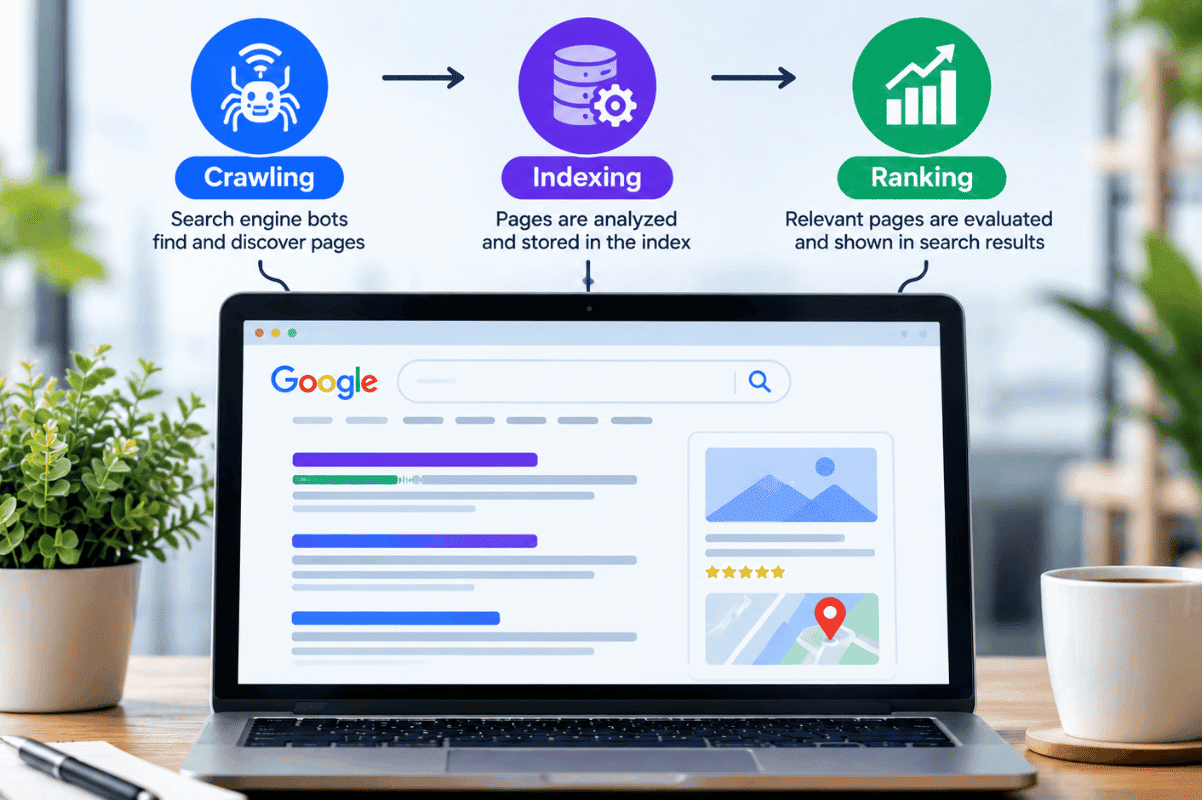
This is why SEO requires a complete strategy rather than one isolated optimisation.
SEO Starts With Search Intent
One of the biggest mistakes marketers make is focusing entirely on keywords.
A keyword tells you what someone typed, but search intent helps explain what they actually want.
For example, consider these searches:
“What is SEO?”
The person probably wants an explanation.
“Best SEO agency for small business”
The person may be comparing providers.
“Buy SEO services”
The person is closer to taking action.
Your content should match the reason behind the search.
If someone wants an educational guide and you give them a sales page, the page may not satisfy their needs. Likewise, if someone is ready to purchase and you only provide a general definition, you may miss the opportunity.
The Role of Content in SEO
Content gives search engines information about your expertise and helps users find answers.
Good SEO content should:
- Answer the main question
- Cover important related topics
- Be easy to understand
- Provide useful examples
- Use relevant keywords naturally
- Demonstrate experience and knowledge
Keyword stuffing is not a substitute for quality.
For example, repeating “SEO services” dozens of times throughout an article does not make the page more valuable. A better approach is to explain the subject thoroughly and use relevant terminology naturally.
Technical SEO Makes Content Easier to Discover
You can publish an excellent article, but technical problems can still make it difficult for search engines and users to access.
Technical SEO can include:
- Website speed
- Mobile usability
- Crawlability
- Indexing
- XML sitemaps
- Canonical URLs
- HTTPS
- Structured data
- Broken links
- Website architecture
Think of technical SEO as the foundation of a house. Your content may be excellent, but the foundation still needs to be strong.
Why Backlinks Matter
Another important part of understanding how does SEO work is understanding links.A backlink is a link from another website to yours.
Search engines can use links as signals when evaluating the authority and relevance of webpages. However, not every backlink has the same value.A relevant link from a trustworthy website can be more meaningful than a large collection of unrelated or low-quality links.That is why sustainable link building focuses on relevance, quality, and genuine value instead of simply trying to increase the number of backlinks.
SEO and Digital Marketing Work Together
SEO should not operate separately from your broader marketing strategy.
SEO and digital marketing can complement each other through content marketing, social media, paid advertising, email marketing, branding, and conversion optimisation.
For example, a business might:
- Publish a helpful SEO article.
- Optimise it for relevant searches.
- Promote it through social media.
- Earn backlinks from industry websites.
- Use analytics to understand visitor behaviour.
- Improve the page based on performance.
- Convert qualified visitors into leads or customers.
Each channel can support the others.
Paid advertising can generate immediate visibility, while SEO can build organic visibility over time. Content can attract visitors, while conversion optimisation helps turn those visitors into customers.

How to Measure SEO Performance
Ranking position is useful, but it should not be your only measurement.
Marketers should also monitor:
- Organic traffic
- Search impressions
- Click-through rate
- Keyword visibility
- Conversions
- Leads
- Revenue
- Indexed pages
- Backlink growth
The most important metric depends on the business objective.
For an ecommerce website, revenue and transactions may matter most. For a service business, qualified leads and phone calls may be more valuable.
SEO becomes much more effective when you connect search visibility to actual business outcomes.
Common SEO Mistakes Marketers Should Avoid
SEO mistakes can waste time and resources.
Some common problems include:
- Targeting keywords without understanding intent
- Publishing thin or repetitive content
- Ignoring technical SEO
- Buying poor-quality backlinks
- Overusing keywords
- Forgetting internal links
- Neglecting mobile users
- Expecting immediate results
- Measuring rankings without considering conversions
Another common mistake is treating SEO as a one-time project.
Search behaviour, competitors, websites, and search engine systems change. Successful SEO requires ongoing improvement.
How Long Does SEO Take to Work?
There is no universal timeline for SEO.
A new website competing in a highly competitive market may need significant time to establish authority. An established website with strong content and technical foundations may see improvements sooner after making targeted changes.
Results can depend on:
- Competition
- Website authority
- Content quality
- Technical condition
- Search demand
- Backlink profile
- Industry
- Location
- Search intent
Be cautious of anyone promising guaranteed first-place rankings within a specific number of days.
SEO is generally a long-term investment rather than an instant traffic source.
Final Thoughts
So, what does SEO mean in practical terms?
It means making your website easier for search engines to discover, understand, evaluate, and connect with people who are searching for what you offer.Understanding how does SEO work requires looking at the entire process, from crawling and indexing to content, search intent, technical optimisation, links, and conversions.And when SEO and digital marketing work together, organic search becomes more than a traffic channel. It can become an important part of a broader strategy for attracting qualified visitors and growing a business.For businesses that already have strong content and technical foundations, quality link building can provide additional authority and visibility. A focused approach through buybacklinks can complement an existing SEO strategy without replacing the fundamentals that make a website useful in the first place.
Frequently Asked Questions
What does SEO mean in simple terms?
SEO means Search Engine Optimization. It involves improving a website so search engines can understand its content and users can find relevant pages through organic search.
How does SEO work for a new website?
SEO for a new website involves creating useful content, establishing a logical website structure, addressing technical issues, targeting relevant search intent, and building authority over time.
Is SEO part of digital marketing?
Yes. SEO is one component of digital marketing. It can work alongside content marketing, social media, paid advertising, email marketing, and other channels.
Does SEO guarantee first-page rankings?
No. Rankings depend on many factors, including competition, relevance, website quality, authority, and search engine systems. No legitimate SEO strategy can guarantee a specific ranking.
How long does SEO take to show results?
The timeline varies significantly. Some changes can produce improvements relatively quickly, while competitive searches may require months of consistent optimisation and content development.
Are backlinks still important for SEO?
Relevant, high-quality backlinks can still contribute to a website’s authority. However, quality and relevance are more important than simply accumulating a large number of links.
